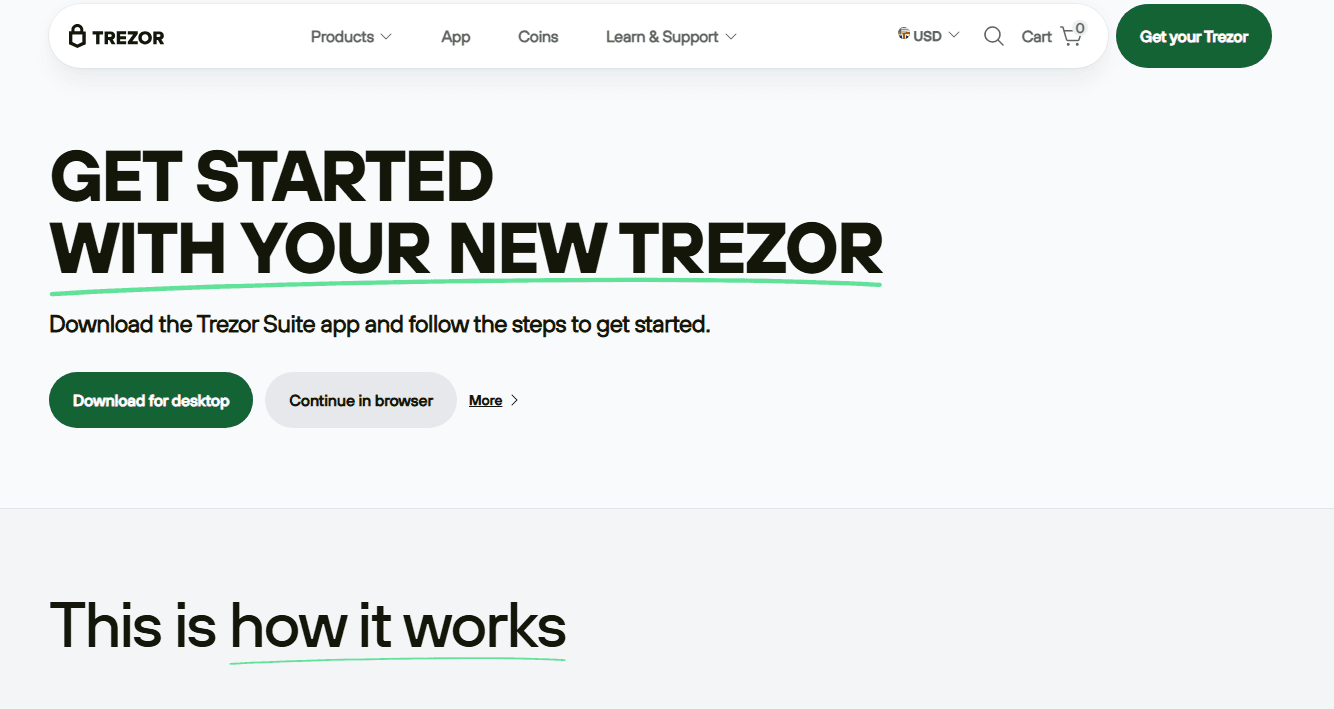
Trezor Login — What It Means & How to Use It Safely
In the world of cryptocurrency, using a hardware wallet like Trezor isn’t just about storing coins — it's about controlling your private keys securely. “Trezor Login” refers to the process of opening and accessing your crypto wallet using your physical Trezor device and companion software (typically Trezor Suite). It’s fundamentally different from logging into an online service with a username and password. With Trezor, login is device-based, offline-enabled, and built around cryptographic security.
This article explains what exactly Trezor login entails, how it works step-by-step, why it’s considered among the safest methods for crypto custody, and how you can use it effectively while avoiding common mistakes.
What Makes Trezor Login Different from Traditional Logins
When most people think of “login,” they imagine a webpage where they type a username and a password. Perhaps they also input a 2FA code. This kind of login depends on data stored on a remote server — and that’s where many risks arise (data breaches, phishing, credential reuse, etc.).
Trezor’s approach rejects all of that:
There is no account stored on a server. You don’t have a username, email, or cloud-stored password with Trezor.
ai-faq-en-trezr.teachable.com
+2
Google Sites
+2
All sensitive secrets — the private keys that grant access to your funds — remain inside the hardware wallet. They never leave the device during login, transaction signing, or other operations.
support-login-trezor.typedream.app
+2
trezor-suite-faqs.framer.ai
+2
To log in, you must physically possess the Trezor device, and enter a PIN directly on the hardware wallet (not on your computer).
about-faq-trezur-en-us.teachable.com
+2
overview---en-treezor.teachable.com
+2
Optionally, you can use a passphrase — effectively a secret “25th word” — which unlocks a hidden wallet. Without the correct passphrase (and the device), these hidden wallets remain inaccessible.
Google Sites
+2
support-login-trezor.typedream.app
+2
Because there’s nothing stored online or in a cloud, threats like phishing, server breaches, password leaks, or remote hacks are drastically mitigated.
trezor-suite-faqs.framer.ai
+2
support-login-trezor.typedream.app
+2
In short: Trezor login provides self-custody, hardware-backed authentication, and zero reliance on centralized servers.
How Trezor Login Works — Step-by-Step
Here’s what happens when you want to log in (or unlock) your Trezor wallet using Trezor Suite (or a compatible interface).
Connect Your Trezor Device
Plug in your Trezor — whether it’s Model One, Model T, or another supported version — into your computer using a USB cable (or USB-C, whichever is required). The moment you connect, the companion software will detect the device and prompt the login process.
about-faq-trezur-en-us.teachable.com
+2
overview---en-treezor.teachable.com
+2
Open Trezor Suite (or Compatible Interface)
Launch the official Trezor Suite app on your desktop (or use a supported web interface). The software will detect the connected device and verify that it's genuine and compatible before proceeding.
gfghjg
+2
trezor.io
+2
Enter Your PIN on the Device
The wallet prompts you to input your PIN — but crucially, this happens on the Trezor device itself, not on your computer. For Trezor One, this uses a randomized PIN pad interface that changes layout each time to protect against keyloggers or screen-recording malware. For touchscreen models, PIN entry happens directly on-device.
about-faq-trezur-en-us.teachable.com
+2
overview---en-treezor.teachable.com
+2
Optional: Enter Your Passphrase
If you have enabled passphrase protection (for extra security or hidden wallets), after the PIN step you’ll be asked to enter your passphrase. This adds an additional layer of security, effectively creating a hidden wallet variation accessible only with that exact passphrase.
Google Sites
+2
ai-faq-en-trezr.teachable.com
+2
Device Verification & Genuine Check
Once PIN (and passphrase, if used) are successfully entered, Trezor Suite may perform a “genuine check” — validating the device’s firmware signature and verifying the hardware wallet is authentic and untampered. This protects against counterfeit devices.
about-faq-trezur-en-us.teachable.com
+2
support-login-trezor.typedream.app
+2
Wallet Access Granted
With authentication complete, you can now view your accounts, check balances, send/receive crypto, manage installed apps for different blockchains, or perform other wallet operations. All with the confidence that your private keys remain safe inside the hardware wallet.
about-faq-trezur-en-us.teachable.com
+1
That’s the full “login flow” — no usernames, no cloud storage, no online credentials. Just hardware-backed authentication and local control.
Why Trezor Login Is Among the Most Secure Options for Crypto Owners
Given the rising wave of hacks, phishing, and credential theft in the crypto world, Trezor’s login model stands out, thanks to a few key strengths:
No Online Credentials to Steal: There’s nothing stored on a server — no password vault, no email-based login, nothing. Attackers have nothing to target in terms of credentials.
trezor-suite-faqs.framer.ai
+1
Private Keys Never Leave the Device: Even when interacting with blockchain or Web3 applications, all signing and private-key operations happen inside the device. The computer or browser never handles raw keys.
support-login-trezor.typedream.app
+2
secure-login-trezor.teachable.com
+2
Protection Against Malware & Phishing: Because PIN entry is on-device and variable (via randomized keypad), malware or keyloggers on your computer cannot capture your PIN. Fake login pages or phishing sites lose power — without the physical device and correct PIN/passphrase, nothing works.
gfghjg
+2
overview-us-treezor.teachable.com
+2
Hidden Wallets via Passphrase: Even if someone acquires your recovery seed (or steals the physical device), they still cannot access any funds stored in a wallet protected by a passphrase. It’s like having a silent, hidden vault within your wallet.
Google Sites
+2
support-login-trezor.typedream.app
+2
User-Controlled and Verifiable: The entire system is open-source and transparent. You don’t rely on a service’s security — you rely on your own control and correct use of hardware + software.
gfghjg
+1
For anyone serious about holding cryptocurrency securely over the long term, Trezor login represents a model of self-custody and resilience against many of the security pitfalls common in software wallets or exchanges.
Common Issues and Troubleshooting During Trezor Login
Even with a robust system, users occasionally encounter difficulties. Here are common problems — and how to address them.
Device Not Recognized
If your computer or browser doesn’t detect the Trezor when connected:
Try a different USB port or cable (some cables are charge-only and don’t support data).
Ensure that the companion software (Trezor Suite) or required bridge/driver is properly installed.
On some systems, you may need specific permissions (especially on Linux) — check OS compatibility.
PIN Entry Problems or Lockouts
If you input the wrong PIN multiple times:
Trezor devices often implement a time delay or even lockout after repeated failed attempts, to prevent brute-force.
If the device locks entirely, use your recovery phrase to restore the wallet onto a fresh device. This is why safely storing your recovery seed is critically important.
Passphrase Confusion
If you enabled passphrase protection but forget the passphrase:
The “hidden wallet” becomes effectively inaccessible. The passphrase is not stored anywhere.
Without the exact passphrase and seed, funds stored under that hidden wallet cannot be recovered.
Firmware or Software Incompatibility
If you haven’t updated the device firmware or the companion software:
Login — or even detection — may fail. Always keep Trezor Suite (or any compatible interface) up-to-date.
Avoid using outdated third-party wallet tools unless they explicitly support the Trezor firmware version you have.
Suspicious Login Requests or Phishing Attempts
Since operations often involve connecting to Web3 apps or external services:
Always ensure you're using trusted websites or interfaces.
Never enter your recovery seed or private keys into any website or form — Trezor login does not require such data.
If a service ever asks for your seed, treat it as malicious and abort immediately.
Best Practices for Secure Use of Trezor Login
To make the most of Trezor’s security, and to minimize user errors, here are recommended habits:
Use the official companion software (Trezor Suite or other trusted, well-known wallets that support Trezor). This ensures integrity and compatibility.
Store your recovery seed offline — write it on paper or use a metal backup, store it in a secure location (safe, lockbox). Never store digitally or take photos.
Enable a passphrase if you’re storing significant assets. Treat the passphrase like a second private key — memorize it or store securely offline.
Use strong, unpredictable PINs — avoid simple sequences.
Always verify on-device prompts before approving any login or transaction. Check addresses, amounts, and network carefully.
Update firmware and software promptly — to benefit from security patches and latest improvements.
Disconnect the device when not in use — when unplugged, your wallet remains inaccessible online.
What “Login” Really Represents with Trezor: Ownership, Not Authentication
It helps to reframe what “logging in” with Trezor means. Instead of thinking of login as “authentication to a service,” view it as proving ownership of your private keys.
Logging in doesn’t grant you access to a service account — it unlocks your own crypto holdings.
The Trezor device + PIN + optional passphrase = your identity and access key. There is no external server that knows you or holds your keys.
Because the system is self-custodial, you are the sole custodian of your assets. Security depends on your vigilance, not on a third-party provider.
This model — while placing responsibility on the user — also gives you maximum control and privacy, aligning with the original ethos of cryptocurrencies.
Conclusion
Trezor login is far more than a simple sign-in procedure; it’s a secure, hardware-based authentication model built for safeguarding private keys and protecting crypto assets from online threats. By requiring physical device possession, PIN entry on the device itself, optional passphrase protection, and never exposing private keys to the internet, Trezor offers a secure, user-controlled gateway to your funds.
If you use your wallet correctly — connect the device, enter the PIN (and passphrase if enabled), verify on-device prompts, and follow security best practices — you benefit from a level of protection that typical online wallets or exchanges cannot match. For anyone serious about crypto custody, Trezor login remains one of the most trusted and robust ways to manage and safeguard digital assets.